

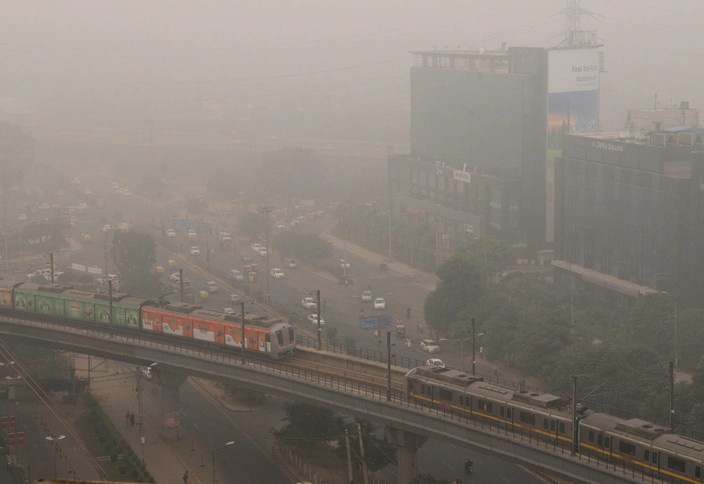
It has been proven that atmospheric air pollution is the main environmental threat to human health worldwide. It is associated with an increase in the number of cardiovascular and pulmonary diseases, including coronary heart disease, stroke, asthma, chronic obstructive pulmonary disease and dementia. vokrugsveta.ru.
Moreover, this problem affects low- and middle-income countries to the greatest extent, where air quality often deteriorates against the background of large-scale urbanization, rapid economic development, and an increase in the number of cars and other means of transport.
In 2021, WHO set new maximum permissible levels for a number of pollutants, including fine particulate matter (PM2.5) and nitrogen dioxide (NO2).
PM2.5 are solid particles with a diameter of 2.5 microns or less; they are so small that they can penetrate deep into the lungs when inhaled. The sources of such particles are vehicle exhaust gases, power plants, industrial processes, wood-burning stoves and fireplaces, as well as construction dust. In addition, they are formed in the atmosphere as a result of complex chemical reactions involving other pollutants such as sulfur dioxide and nitrogen oxides.
Nitrogen dioxide is one of the main pollutants that occur during the burning of fossil fuels. It is present in the exhaust gases of cars (especially with diesel engines), industrial emissions, and is also released when using gas stoves and heaters.
The researchers, whose article was published in the journal Environment International, analyzed information from 136 low- and middle-income countries around the world. The scientists combined detailed data on air pollution, population size and health status with the results of scientific research on the relationship between environmental pollution, morbidity and mortality.
Using computer simulations, the researchers estimated how the number of deaths and new cases of diseases could change if concentrations of certain pollutants decreased to levels recommended by the WHO.
The results showed that for PM2.5, reaching the WHO recommended thresholds could prevent or delay about 9.4 million deaths per year, and for nitrogen dioxide, about 1.1 million deaths per year.
Moreover, even meeting less stringent interim targets can bring significant benefits to public health: the number of deaths associated with exposure to PM2.5 may decrease by about 6.6 million, and those related to nitrogen dioxide by 435 thousand.
The potential benefits of air purification are not limited to preventing deaths, scientists have found. According to the researchers, achieving the recommended levels of PM2.5 could lead to a reduction in the number of new cases of chronic obstructive pulmonary disease by 2.8 million, dementia by 1.1 million, coronary heart disease by 7.3 million, and stroke by 2.3 million per year.