
For farmers and smallholders, the land is life, water is its lifeblood, and the harvest sustains the household. We spend our lives in the field, from which we obtain bread, cotton, fruit and vegetables; we feed our families and help provide for our country. Our love for the land is so deep that we know every inch of it like the palm of our hand. However, science is warning that a new, invisible threat is gradually entering our precious soil, water and food. Its name is microplastic pollution. Today, I want to explain this issue in language every farmer can understand. The solution begins not only in laboratories in large cities, but also in our own fields and in the daily decisions of every farmer.
What are microplastics?
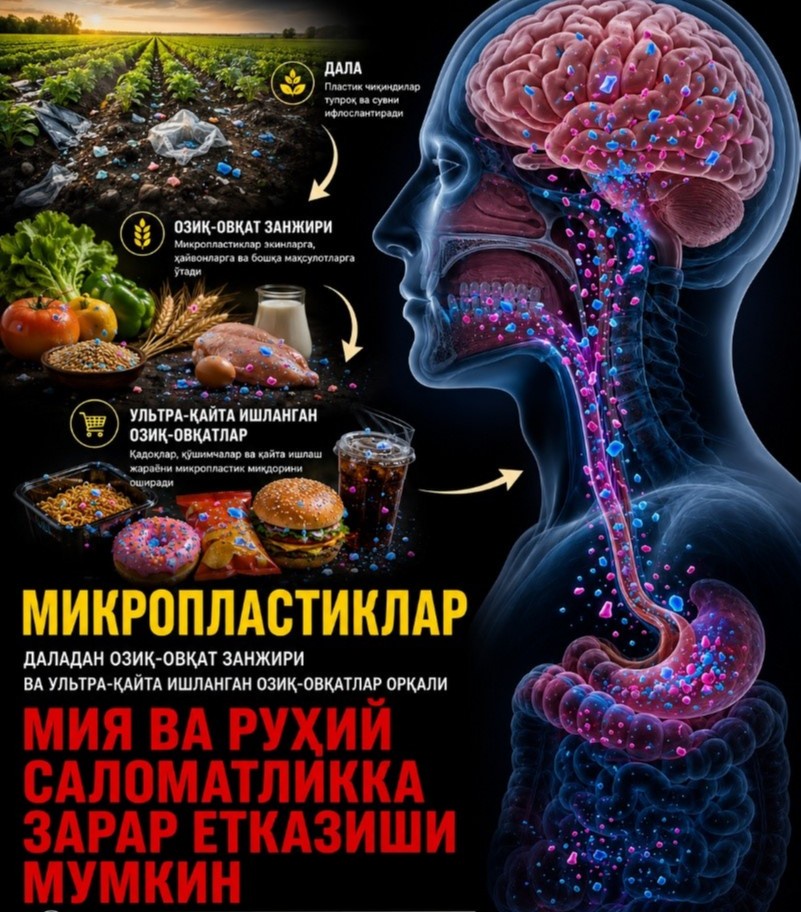
Plastic has become so deeply embedded in our lives that it is difficult to imagine even one day without it. Plastic bags, irrigation tape, mulch film, fertilizer sacks, plastic bottles and chemical containers are becoming increasingly common both in our fields and around our homes. The greatest problem with plastic is that most types do not decompose or disappear as quickly as natural materials do. Sunlight, heat and cold, wind, friction and soil cultivation gradually break large pieces of plastic into smaller fragments.
Plastic particles smaller than five millimetres are generally called microplastics. Extremely small particles below one micrometer are often referred to as nanoplastics, although international science has not yet adopted a completely uniform standard for these size boundaries. Put simply, a piece of film abandoned in a field does not truly disappear: it can fragment into thousands of invisible particles, remain in soil and water for a long time, and eventually enter the food system.
Where does plastic left in the field go?
Many farmers may feel reassured by the thought: “I have tidied the area and moved the waste aside, so the field is clean.” In reality, plastic left on agricultural land can travel through several interconnected pathways, each of which may ultimately bring it back to people.
The first pathway is soil. Pieces of film, tape and bags left in the field become mixed with the soil during cultivation, move deeper into the ground and continue to fragment over many years. Agricultural soils are becoming important reservoirs of plastic pollution. Depending on the type, size and quantity of the particles, they may affect soil structure, porosity, the movement of air and water and the beneficial organisms that help maintain fertility.
The second pathway is water. Small plastic fragments can move through canals, collectors, drainage systems and irrigation water from one field to another and onward into rivers, lakes and groundwater. A piece of plastic left in your field today may therefore reach a neighboring field tomorrow and later spread through the wider water system. No farm is completely isolated from the others.
The third and most concerning pathway is the plant-and-food chain. Experimental studies show that very small particles, especially nanoplastics, can, under certain conditions, enter plants through roots or leaves and move into other tissues. Larger microplastics may indirectly harm plants by altering soil conditions and affecting the uptake of water and nutrients. Evidence from real field conditions is still accumulating, but the possibility of effects on photosynthesis, growth and crop quality is itself a sufficient reason to begin preventive action today.
What do the numbers tell us?
A major international analysis published in 2025 compiled thousands of observations of terrestrial plants and freshwater and marine algae. The authors estimated that exposure to microplastics may be associated with a reduction in photosynthesis of about 7-12 percent. A model built on those relationships projected possible global annual losses of approximately 110-361 million tonnes of major crops. Although these figures are preliminary scientific projections, they show that plastic pollution is a serious issue for agriculture and food security.
This is not only a question of crop yields. Microplastics have been detected in drinking water, table salt, honey, sugar, certain beverages, seafood and other foods. Estimates of how many particles people ingest vary greatly because detection and measurement methods have not yet been fully standardized. Laboratory and animal studies are examining possible mechanisms, including inflammation, oxidative stress and cellular damage. Extremely small nanoplastics may cross biological barriers more easily, but the health risk posed by the amounts currently detected in food has not yet been conclusively established.
This uncertainty is not a reason for panic, but neither is it a reason for indifference. The Food and Agriculture Organization of the United Nations (FAO), the European Food Safety Authority (EFSA) and the United States Food and Drug Administration (FDA) are examining the issue seriously. Their cautious conclusion is that micro- and nanoplastics are entering environmental and food systems. Still, high-quality research, harmonized measurement methods and more reliable data are needed to assess the level of risk accurately.
What does this have to do with us?
Some may ask: “Microplastic pollution is a problem of oceans, seas and waste from large cities, so what does it have to do with our dry fields?” In fact, agriculture is an important link in the plastic cycle. Irrigation tape, mulch film, fertilizer, pesticide packaging and seed and seedling containers can become direct sources of pollution when they are not properly collected. At the same time, microplastics may also reach fields through contaminated irrigation water, compost and other organic amendments, atmospheric deposition, wastewater, and road and tire dust.
I am not saying this to blame anyone. On the contrary, it means that a major opportunity lies in our own hands. Solving the global plastic problem requires reliable collection infrastructure, producer responsibility, recycling, science and clear policy. Yet every farm can begin today with a simple, low-cost first step: do not leave visible plastic waste in the field.
The solution is simple: an environmentally clean field
For this reason, when we recently announced eight important laws of cotton production, we named the final one - the eighth law - “The Environmentally Clean Field.” This was not accidental. Sowing, irrigation, nutrition, protection, ripening signals, defoliation and desiccation are all important agronomic rules. Yet the law that crowns them all is a culture of care and responsibility in the field. An environmentally clean field protects four things at once: soil, water, the crop we grow and human health.
What does this mean in practice? Pieces of plastic bags, film and irrigation tape can mix into the soil, wrap around machinery and block waterways. They should be collected separately, removed from the field and delivered to an authorized collection, recycling or safe-disposal channel. Fertilizer and biostimulant sacks should be collected as soon as work is completed and stored in a dry, controlled place. Where plastic use is unavoidable, durable, recoverable products that meet quality requirements should be selected. A label saying that a product is “degradable” does not mean that it may be left in the field.
Pesticide and herbicide containers require the greatest caution. Residues left inside them may be dangerous to people, animals, water and soil. Such containers must be stored separately and transferred in accordance with authorized procedures and the product label, in accordance with applicable national requirements. Chemical containers must never be used to carry water, store food or livestock feed, or for household purposes. Wire, glass and other hard waste found in the field should be collected immediately and placed in a safe container to prevent injury to workers or animals and damage to machinery.
Two mistaken ideas must be rejected. The first is leaving a piece of film in the field on the assumption that “one small piece cannot do any harm.” Over the years, that single piece may break down into many small, persistent particles. The second and even more harmful mistake is burning plastic in the field. Burning does not eliminate the problem: it can release harmful substances into the air and return contaminated ash and residues to the soil. The correct approach is not to abandon, burn or carelessly bury waste, but to collect it systematically and transfer it to the appropriate system.
Field cleanliness is continuous, not seasonal
Many people think that field cleaning is a task carried out once at the end of the season. That is not enough. An environmentally clean field requires continuous attention throughout the growing period and across all seasons. Farmers should regard it as a natural part of their work, just like irrigation, fertilization or crop protection.
In practice, the routine is simple. Before sowing, the field is cleared of plastic and hard waste. After every fertilizer application, spraying operation and irrigation event, the field is inspected. Waste bags or bins are provided for workers and machine operators. Agrochemical containers are kept separate from other waste, and nothing is thrown into canals, collectors or field roads. Before harvest, any plastic that could become mixed with the produce is removed; at the end of the season, the field, farm shelter and machinery area are fully cleaned. Keeping a simple record of how much film, tape and packaging enter the farm and how much is collected and delivered also strengthens accountability. For this work to be effective, convenient district collection points and a reliable transport system must also be established.
The Clean Field Challenge: a movement launched across the country
Most encouragingly, this initiative has not remained on paper or become merely a slogan. It has grown into a practical, nationwide movement. In July 2026, the Ministry of Agriculture declared a “Plastic-Free Month,” and farms in every region of the country began clearing their fields of plastic containers, packaging and other waste.
On social media, the movement became known as the “Clean Field Challenge.” Farmers, smallholders and dedicated agricultural professionals are uniting around one goal: clean soil, safe crops and a healthy future. Every plastic container collected is one less item that will fragment in the soil, and every cleaned field contributes to sustainable agriculture and safer food. This initiative is not for display or reporting; it is sincere work to protect the soil, prevent new microplastic pollution and safeguard tomorrow’s harvest.
To make the problem visible to farmers, a simple yet powerful practical initiative is being proposed, with the participation of regional agricultural specialists and responsible representatives of the ministry and local authorities: together with the farmer, they clean just 20 square meters of the field and place all the collected waste in a single visible location. These twenty square meters are not intended to replace cleaning the whole field. Their purpose is to lead by personal example and to act as a mirror, revealing the amount of plastic that the farmer may no longer notice because it has become part of the everyday landscape. When the waste collected from such a small area is laid out in one place, it immediately becomes clear that the problem is not an abstract one. When a specialist or responsible official begins the work with their own hands, the action is not a reprimand but a practical example and an invitation to cooperate. This small demonstration should encourage the farmer to inspect the entire field, collect the waste and make cleanliness a permanent habit.
I therefore call on every farmer, smallholder, agronomist, agricultural-cluster manager, district official and fellow citizen to join this worthy effort. Take part in the Clean Field Challenge, clean your field, and use photographs and videos of your work to set an example for others. A clean field is not merely an obligation; it is a culture. It reflects the farmer’s respect for the land, responsibility for their work and conscience before future generations.
Hope for the future: science is also seeking solutions
I do not want to end this discussion only with danger. Whenever humanity encounters a problem, it also searches for a solution. In the field of micro- and nanoplastics, science has begun to explore promising biological approaches.
In 2026, researchers at the World Institute of Kimchi in the Republic of Korea studied a lactic acid bacterium isolated from kimchi, Leuconostoc mesenteroides CBA3656. Under standard laboratory conditions, it bound approximately 87 percent of the polystyrene nanoplastics used in the experiment. Under conditions designed to simulate the human intestine, the binding rate was approximately 57 percent. In experiments with germ-free mice, groups given the bacterium excreted more than twice as much nanoplastic naturally as control groups that did not receive it.
Of course, these findings must not be exaggerated. The study involved one bacterial strain, one type of polystyrene nanoplastic, controlled laboratory conditions and germ-free mice - not humans. It does not prove that eating kimchi removes microplastics from the human body, nor has it yet shown that increased excretion prevents particles from accumulating in tissues or produces a health benefit. Human studies and broader experiments with other types of plastic are needed. Nevertheless, the work points to a scientifically grounded direction for future research. What might it mean? Some food-derived microorganisms could one day become biological agents that bind particular pollutants in the intestine and help promote their elimination.
The most important lesson is this: nature may help us find solutions, but first we must stop the pollution we can prevent ourselves from causing. A beneficial bacterium may one day bind a small quantity of particles in the intestine, but it cannot clean plastic scattered across an entire field. A clean field always begins with human responsibility.
A clean field - a clean table
Microplastic pollution is not an unfamiliar, distant or foreign problem; it is a problem right beside us. Plastic particles are being detected in soil, water and food systems around the world. Yet part of the solution is also close at hand: it lies in the daily habits of every farm, at the edge of every field and in the way we treat every piece of waste.
Science is giving us both a warning and hope. The warning is that plastic pollution can impair soil functions, interfere with plants and enter the food chain. The hope is that prevention, good waste management, innovation and future biological methods can help reduce the harm. Between these two truths, the most important link is us - the farmers. When we keep the field clean, we protect the soil; healthy soil produces a quality crop; a quality crop supports a safer table; and a safer table supports a healthy family.
My message to every farmer today is simple but powerful: keep the field clean. Do not leave plastic in the field, burn it or bury it carelessly. Collect it systematically and deliver it through an appropriate collection or recycling channel. Let us turn the Clean Field Challenge and Plastic-Free Month from a one-season campaign into a permanent habit. This is one of the simplest yet most honorable things we can do for our harvests, the health of our country and the tables of future generations. Let us leave our children clean soil, clean water and a clean table.
Ibrokhim Abdurakhmonov,
Minister of Agriculture of the Republic of Uzbekistan, Academician