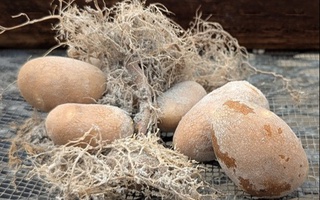

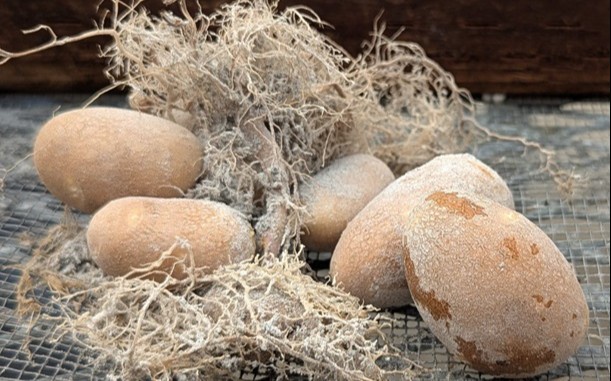
Future residents of permanent lunar bases will potentially be able to grow their own potatoes directly on the Earth's satellite, Popular Science reports. Botanists from the University of Oregon in the USA have experimentally confirmed that potatoes can successfully grow in artificially reproduced lunar soil provided organic substances are added.
One of the main problems of the future agriculture on the Moon is the peculiarities of the local soil. Regolith contains practically no organic substances and is not capable of providing plants with the necessary nutrients on its own. In addition, it contains heavy metals, and the lunar surface is constantly exposed to cosmic and solar radiation. Therefore, scientists were not sure whether conventional agricultural additives could compensate for the negative properties of such an environment.
To test this hypothesis, the researchers created an artificial lunar regolith, the composition of which reproduced the characteristics of samples collected during the Apollo space missions. The resulting material was then mixed with vermicompost, a nutrient—rich organic mixture that results from the processing of organic materials by earthworms.
After that, the scientists planted potatoes in a mixture with different proportions of regolith and vermicompost and observed the development of the plants.
The results of the experiment were encouraging. It turned out that to obtain a crop comparable to growing potatoes in ordinary soil, a mixture containing only 30% of vermicompost is sufficient. Probably, organic components help to reduce the toxic effects of heavy metals contained in the regolith and protect the root system of plants.
However, the very fact of harvesting does not guarantee that such potatoes will be safe for consumption. Therefore, the researchers separately tested its chemical composition, paying special attention to glycoalkaloids, natural toxic compounds found in potatoes. Their increased concentration can pose a danger to humans, and the accumulation of these substances is associated, in particular, with the greening of tubers.
The analysis showed that there was no statistically significant increase in the concentration of glycoalkaloids in potatoes grown in artificial lunar soil. This indicates that, under appropriate growing conditions, the resulting crop can be suitable for consumption.
The next stage of the work will be a comparison of ten varieties of potatoes grown in artificial lunar regolith. Scientists plan to determine which of them are best adapted to such conditions, have the highest nutritional value and will be able to ensure a stable harvest on the Moon. korrespondent.net.
Earlier it was reported that NASA announced the creation of a base on the Moon for $ 20 billion.