
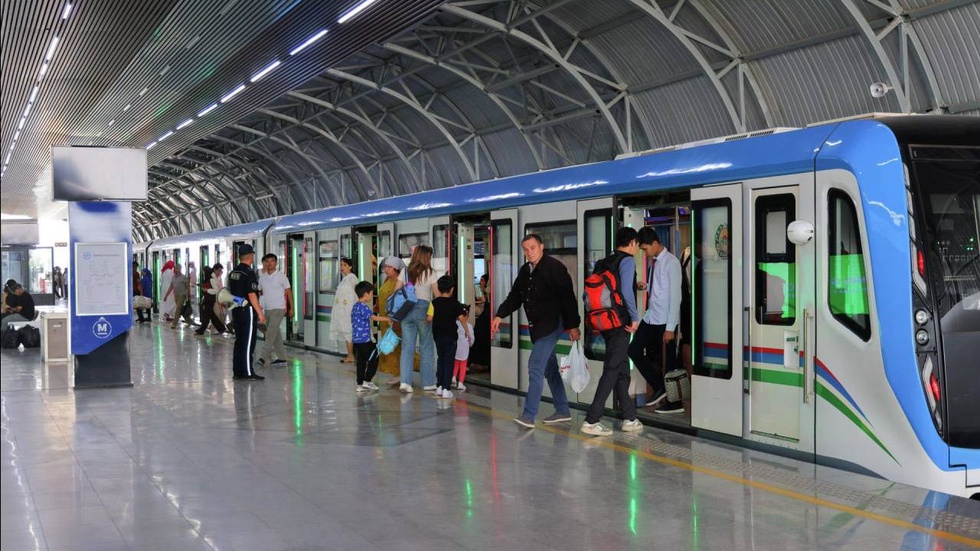
This is evidenced by the dynamics of passenger traffic. So, in September-October 2025, 51.4 million passengers used metro services, while for the same period in 2026 this figure was 61.7 million people. Thus, passenger traffic increased by 20% compared to the corresponding period last year. Currently, the metro serves more than 1.2 million passengers daily.
To date, the Tashkent Metro's carriage fleet consists of 55 modern and 30 obsolete trains, the service life of which has expired. There is a significant difference in passenger capacity between them: if the old trains are designed to carry up to 1,000 passengers on average, the capacity of the new ones reaches 1,300 people.
To increase the efficiency of transportation, train travel intervals on the lines have been reduced as much as possible. Additional reserve trains are sent to stations with the most intensive passenger traffic, if necessary. In addition, responsible staff are on duty to ensure safety and order during passenger boarding and disembarkation.
Taking into account the constantly growing passenger traffic, measures are being consistently implemented to upgrade the metro's rolling stock and increase its carrying capacity. In particular, the Government provides for the purchase of 28 modern five-car trains for the Tashkent Metro in 2027-2028.
At the same time, it is planned to increase the number of wagons in another 40 operating modern trains to five by purchasing additional wagons. The implementation of these measures will expand passenger transportation opportunities, increase train capacity and improve the quality of passenger service.
Dear passengers!
The effective operation of the metro, the creation of comfortable conditions for passengers and ensuring the safety of transportation depend not only on the organizational and technical measures taken, but also on the observance by each passenger of the established rules of conduct.
In this regard, JSC "Toshkent Metro" asks passengers to take into account the following recommendations:
Spread evenly across the train cars. Use not only the head cars, but also the middle cars - the second and third. This will avoid excessive crowding of passengers in individual carriages and distribute passenger traffic more evenly.
If possible, choose alternative stations with less congestion.
For example, instead of the Chilonzor metro station, which is used by an average of 60-65 thousand passengers during the day, you can use the Mirzo Ulugbek station, where the average daily passenger traffic is 20-25 thousand people.
Similarly, instead of the Khalklar Dystligi station, which serves an average of 35-40 thousand passengers per day, you can use the Milliy Bog station, which has a passenger traffic of 6-8 thousand people per day. This approach will help reduce the load on the busiest metro stations.
If possible, use new trains with more passenger capacity. This will make it possible to distribute passenger traffic more efficiently and reduce the load on outdated trains.
Before boarding the train, be sure to wait for the passengers to exit. Do not prevent people from exiting the carriage.
Prepare to leave in advance. When approaching the desired station, head to the carriage doors in advance, without causing inconvenience to other passengers.
Strictly observe the safety rules at stations and in train cars.
Remember: ensuring comfort, order and safety in the subway is our shared responsibility!
JSC Toshkent Metro will continue to work consistently to improve the quality of passenger service, expand the capabilities of the metro and improve the services provided.
Passengers are asked to show mutual respect, understanding and responsibility, comply with the established rules and contribute to ensuring comfortable and safe operation of the Moscow metro.