
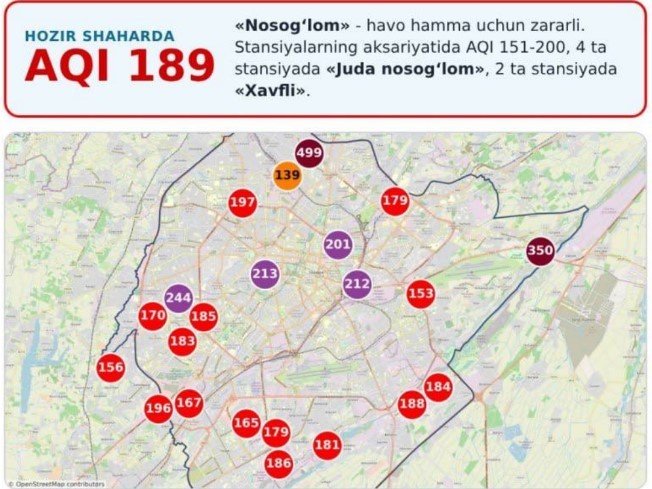
According to the National Committee on Ecology and Climate Change, during the night, according to the International Air Quality Index (AQI) It was mostly assessed as "unhealthy", and in some periods as "very unhealthy".
According to the national air quality index, the average level of pollution by PM2.5 particles in the city corresponded to the "orange" category, and by PM10 particles to the "red" category.
A decrease in temperature, a very weak wind and a temperature inversion contributed to the change in air quality. These conditions limited air exchange in the atmosphere, creating prerequisites for the accumulation of local emissions and PM particles in the surface air layer.
The observed short-term light precipitation (0.1 mm) did not significantly affect the decrease in the concentration of PM particles in the air.
In addition, at night, specialists from the State Institution "National Center for Environmental Monitoring" conducted instrumental measurements of atmospheric air in Yunusabad, Almazar, Shaikhantakhur, Mirzo-Ulugbek, Mirabad, Chilanzar and Uchtepa districts.
According to forecasts, today, on October 29, the air quality in Tashkent will correspond to the category "unhealthy" according to the international AQI index and the category "orange" according to the national index. In the evening, the air quality may also remain at unhealthy levels.