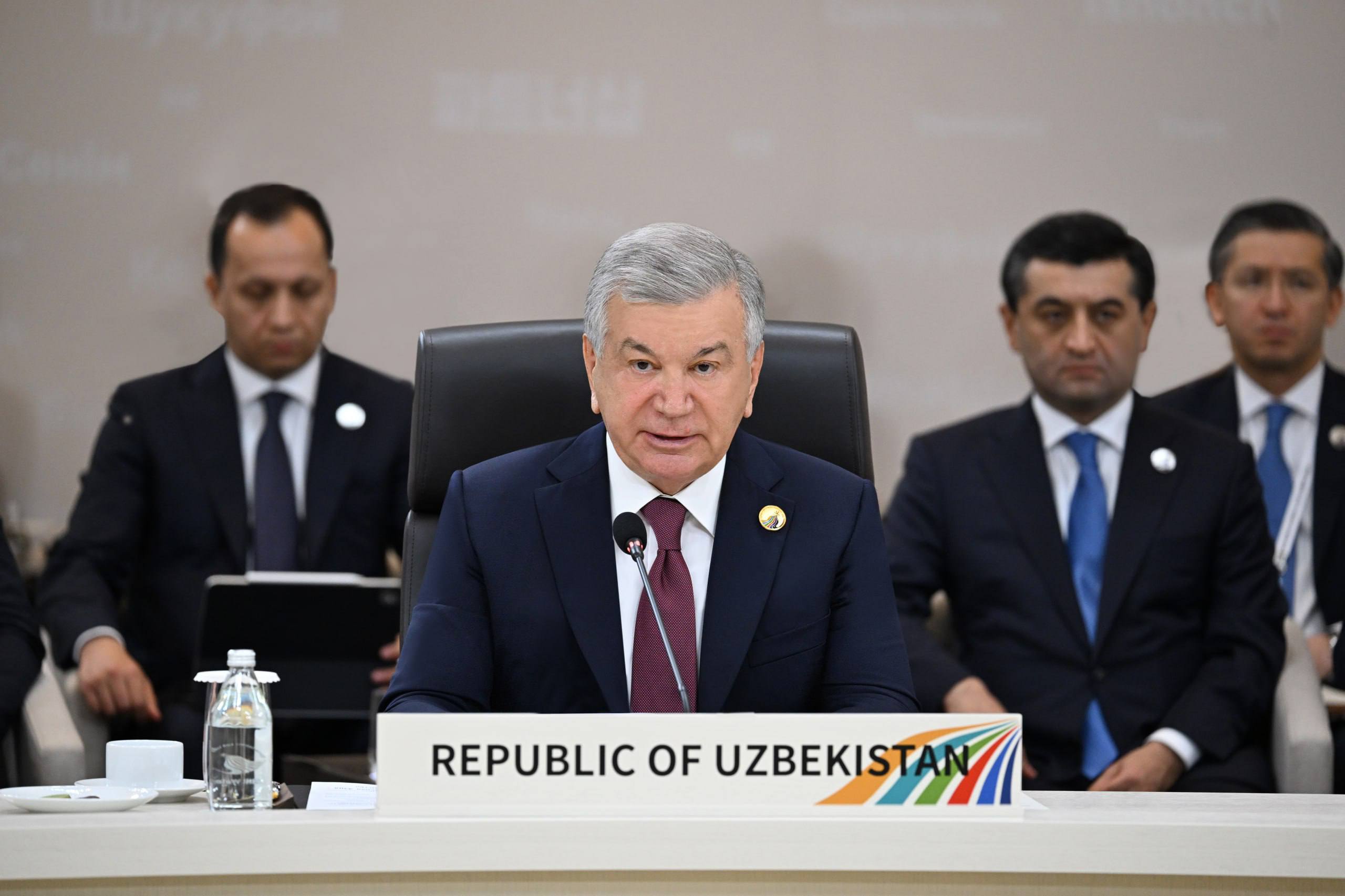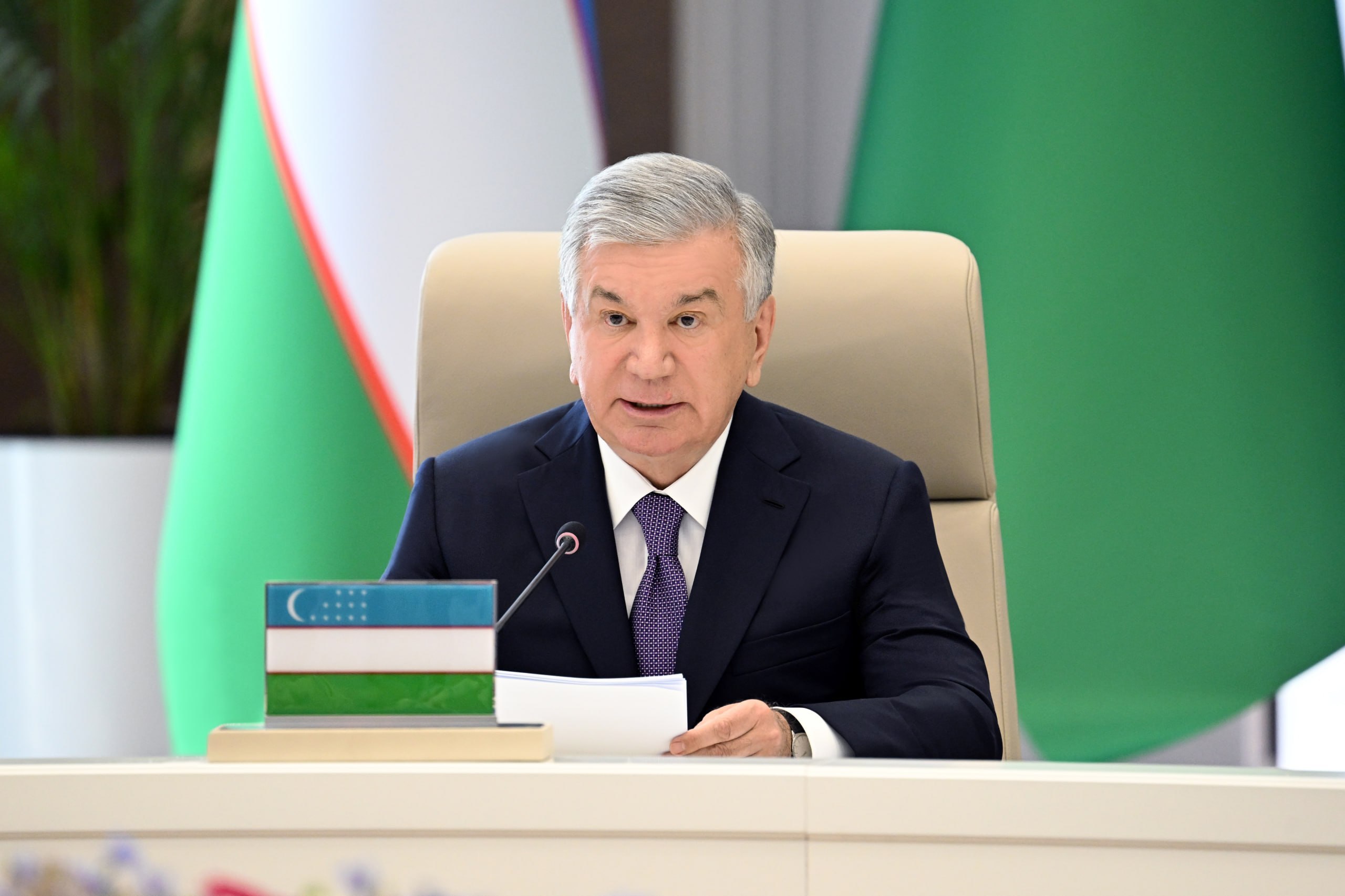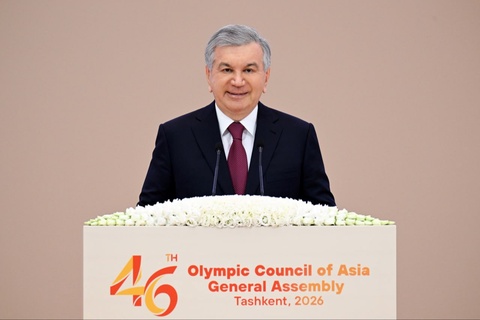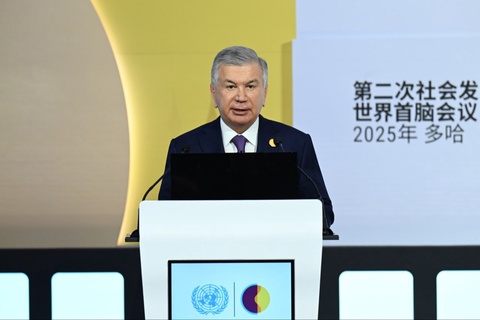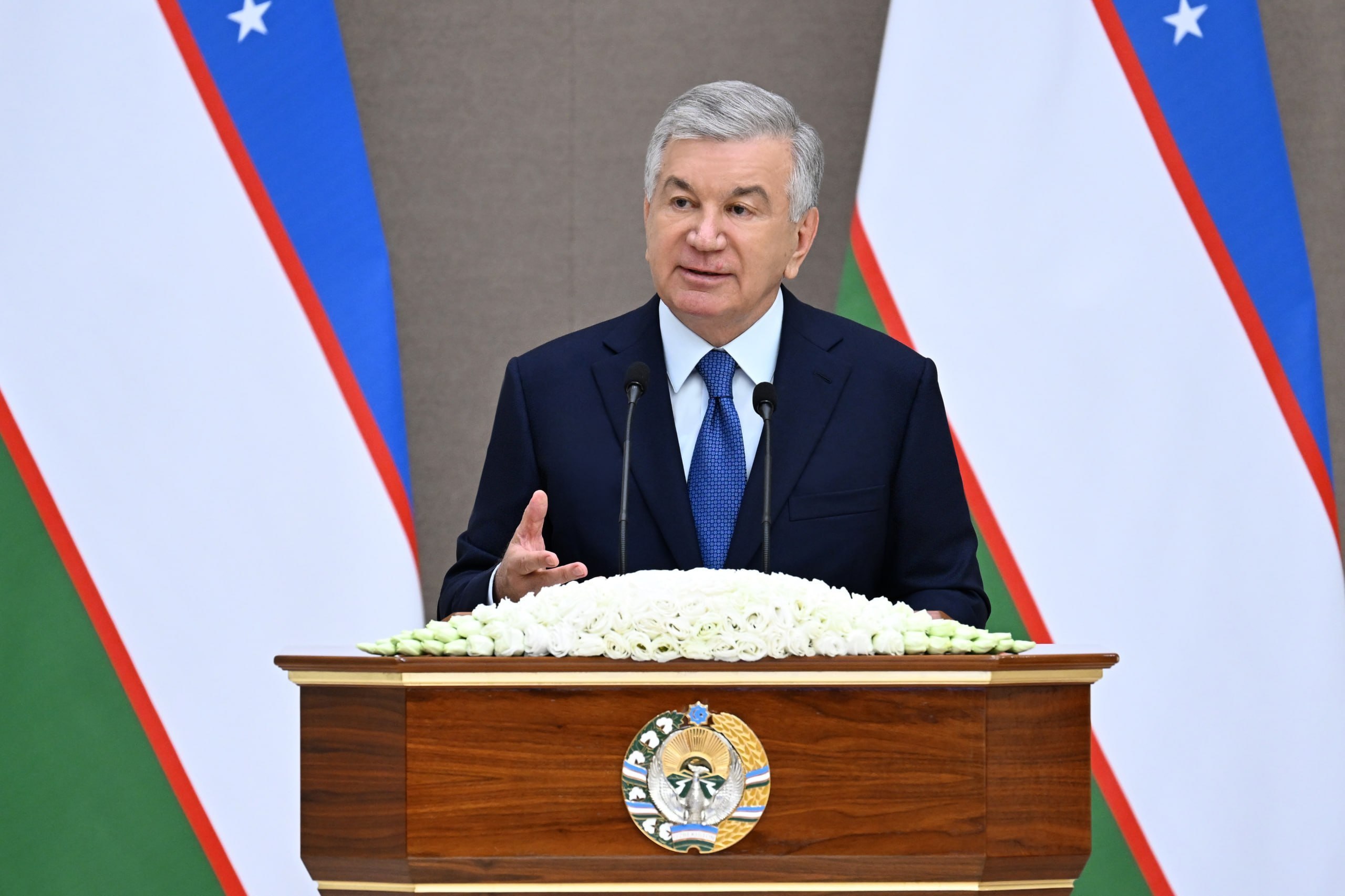

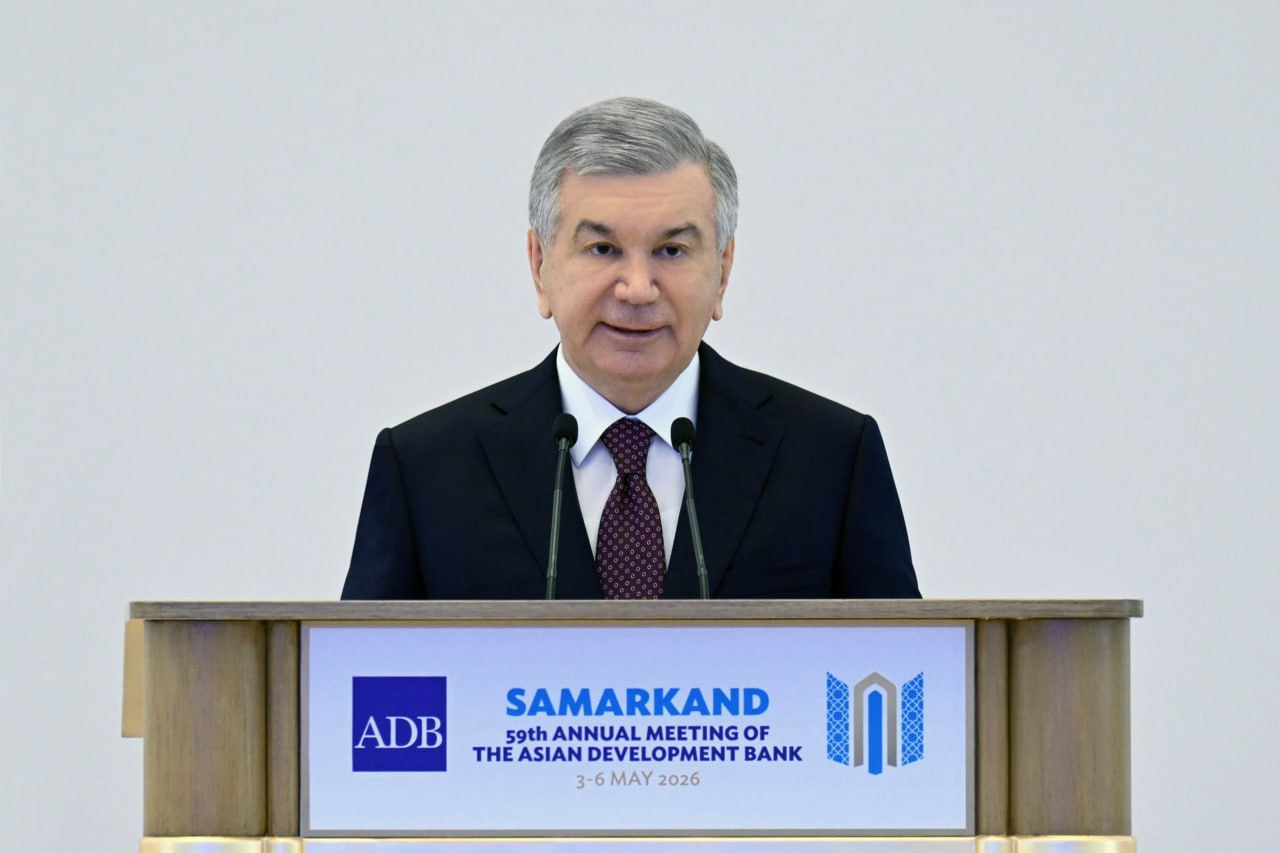
It is my sincere pleasure to welcome you to the 59th Annual Meeting of the Board of Governors of the Asian Development Bank. It is a great honor and privilege for us to host such a prestigious forum.
Our land, with a history spanning several millennia, located at the crossroads of the Great Silk Road, has long been a center connecting East and West, North and South. The paths of world civilization, science, and trade have always converged here.
New Uzbekistan, embracing both a rich history and a bright future, is emerging as a leading platform for discussions on pressing global issues. I am confident that the Samarkand forum will serve to advance progressive ideas and new initiatives, and facilitate important decision-making.
Welcome to New Uzbekistan!
Dear guests!
Today, our country's economy is undergoing an entirely new phase of development. Since 2016, we have embarked on major reforms to liberalize the economy, create an attractive investment environment, participate proactively in global value chains, renew the social and production infrastructure in the regions fundamentally, and improve living standards.
In a historically short period of time, we have gone through a challenging path of development along with our hardworking and creative people. In recent years, our economy has attracted 150 billion dollars of foreign investment, and thousands of modern enterprises have been launched.
Through investment projects worth 35 billion dollars in the energy sector alone we have increased electricity production by 1.5 times, bringing it to 87 billion kilowatt-hours.
During this period, exports of goods and services tripled, and the volume of our economy grew from 50 billion to 147 billion dollars.
These positive results are being acknowledged by the international community. Since 2020, Uzbekistan has consistently improved its sovereign credit ratings.
In the Index of Economic Freedom, our country moved up 14 positions this year and, for the first time, joined the ranks of states with a "moderately free" economy.
Even amid global instability, our economy achieved 8.7 percent growth in the first quarter of this year.
Most importantly, our reforms have focused primarily on improving the daily lives of every single family and individual.
During this period, we increased the income of 8.5 million people in need, reducing the poverty rate from almost 35 percent to 5.8 percent today.
Over the past decade, Uzbekistan has been one of the five countries that demonstrated the most substantial progress in achieving the Sustainable Development Goals.
By 2030, we intend to transform all sectors into technologically and innovation-driven growth model, thereby increasing the size of the economy to over 240 billion dollars. As a result, we aim to join the ranks of upper-middle-income countries and eradicate poverty completely.
In the near future, 30 percent of the shares in the National Investment Fund, comprising the assets of 13 major strategic enterprises, will be placed on the international capital market.
I am confident that this significant step will further bolster the trust of our partners in the investment climate of our country.
Dear friends!
We particularly acknowledge the role of the Asian Development Bank and other international financial institutions in the large-scale reforms being implemented in Uzbekistan.
In partnership with the Bank, which has become our trusted strategic partner, we are implementing projects worth nearly 16 billion dollars.
We highly value ADB’s steadfast partnership from the outset in the areas of renewable energy, rural housing construction, and economic cooperation in Central Asia.
Taking this opportunity, I express my sincere gratitude, on behalf of myself and our entire nation, to the President of the Asian Development Bank, Mr. Masato Kanda, and to the Board of Governors of the Bank for their unwavering support.
I would also like to extend my special thanks to the leadership of the World Bank, the International Monetary Fund, the Islamic Development Bank, the Asian Infrastructure Investment Bank, the European Bank for Reconstruction and Development, and other international financial institutions, as well as to all our foreign partners, for their close cooperation.
Distinguished participants!
We have outlined specific plans with the Asian Development Bank to further expand our close cooperation in important areas such as poverty reduction, human capital development, and modern infrastructure construction.
Indeed, the previous day we signed a new cooperation program with the Bank worth 12 billion dollars.
As you are all well aware, the global economy is experiencing complex changes and new technologies are emerging rapidly in today's turbulent times.
Given this, it is necessary for us to introduce jointly with the Bank new mechanisms and effective approaches to ensure sustainable development.
First, digital technology and artificial intelligence are currently transforming virtually all sectors into entirely new formats.
According to World Trade Organization forecasts, international trade turnover will increase by an additional 40 percent due to artificial intelligence by 2040.
We are fully committed to developing information technologies. We have initiated the establishment of an Artificial Intelligence Hub in Uzbekistan, based on innovation and knowledge.
We are developing more than 200 artificial intelligence projects spanning various sectors of the economy.
We are implementing programs to expand data centers, supercomputers and AI laboratories in the regions, and to train "Five Million AI Leaders".
I would particularly like to emphasize that the Asian Development Bank and our partners in the USA, Saudi Arabia, the UAE, Japan, South Korea and China are providing us with considerable support in these areas.
The use of open AI models is, of course, also required in areas that are most essential to the population's primary needs, such as education, healthcare, water management, ecology and food security.
To this end, we propose implementing a special program under the auspices of the Asian Development Bank to scale up artificial intelligence in developing countries.
We also announce our participation in the Bank's "Digital Highway for Asia" initiative and propose opening its regional coordination center in Tashkent.
Second, the development of digital technology and artificial intelligence is, in turn, sharply increasing the demand for energy resources.
According to analysis by the International Energy Agency, the demand of data centers for electricity is expected to increase two to threefold by 2030.
Against this backdrop, only countries that can offer investors cheap, reliable and "green" energy will be able to remain competitive in the global market.
We have made significant progress in this field: in collaboration with the world's leading companies, we have launched large-scale wind and solar power plants with a total capacity of 5,600 megawatts, thereby bringing the share of "green" energy in generation up to 30 percent. We plan to increase this figure to 54 percent by 2030.
Overall, our region has enormous potential for renewable energy generation. We gratefully acknowledge the support of the Asian Development Bank in creating the Central Asia–Europe "green" energy corridor to expand clean energy exports. We are confident that the countries of the region, in cooperation with the Bank, will launch this "energy artery" project in the near term.
Third, ensuring the stability of interconnected transport systems and logistics corridors is becoming a most urgent issue.
In light of conflicts around the world, changes to logistics corridors are already causing freight costs for Central Asian countries to rise by up to 30 percent, and delaying delivery times by several weeks.
As you know, construction work is underway on the "China–Kyrgyzstan–Uzbekistan" railway project, connecting East and West. This new transport route will greatly enhance the transit capacity of the entire region. Delivery times will be reduced by up to 10 days, creating the capacity to transport up to 15 million tons of cargo per year.
In this regard, we propose establishing a "Digital Customs and Logistics Alliance" within the framework of the Bank's Central Asia Regional Economic Cooperation (CAREC) program.
This will create the opportunity to streamline customs procedures, digitize document flow, and facilitate cross-border cargo transportation.
Fourth, we are interested in further strengthening our cooperation with the private sector through the Bank's participation.
In particular, we acknowledge the intensifying competition for critical minerals in the current technological age. According to international experts, demand for minerals critical to industry will increase sixfold by 2040. This presents a new opportunity.
Uzbekistan holds significant reserves of copper, tungsten, molybdenum, magnesium, graphite, vanadium and titanium, among other minerals.
To harness this potential, we have set up an R&D center with our Korean partners and are building the "Future Metals Technopark" in Tashkent and Samarkand regions. We have launched over 70 projects worth 1.6 billion dollars in collaboration with major companies from the USA, China and Turkiye.
In addition to extracting minerals, we aim to stimulate economic development through deep processing. We propose joining the Asian Development Bank's "From Critical Minerals to Manufacturing" program and implementing projects with high added value within its framework.
In this context, we consider it important to introduce advanced technologies and digital solutions in geological exploration; apply environmental standards to extraction and processing operations; and create sustainable supply chains for critical minerals.
Fifth, climate change and desertification are having a serious impact on the development of Central Asian countries.
In order to mitigate the consequences of environmental problems, we have been planting 200 million seedlings annually under the national "Green Space" project for the past five years. We have created two million hectares of green protective forests on the dried bed of the Aral Sea. We have set ambitious targets to bring the level of greenery in Uzbekistan to 30 percent by 2030.
At the same time, the ADB is effectively implementing its Climate Action Plan aimed at 2030. The Bank is allocating at least 50 percent of its annual budget to financing climate projects.
I believe that undertaking such noble efforts in collaboration with the Bank and the countries of the region will yield even greater results. Therefore, we propose implementing the regional project "Central Asia Green Belt".
Sixth, due to unrest around the world, millions of tourists are looking for safe destinations.
Central Asia has great potential in the tourism sector, particularly in areas such as pilgrimage, cultural, gastronomic, ethno, extreme, and medical tourism.
We have paid special attention to this sector, implementing reforms to ensure the necessary infrastructure, services, visas and transport arrangements, and most importantly, tourist safety. As a result, over the past ten years, the number of foreign tourists visiting Uzbekistan has increased sixfold, reaching 12 million.
The recently opened Islamic Civilization Center in Tashkent, recognized as the scientific and spiritual treasury of Central Asia, and the Imam Bukhari Memorial Complex in Samarkand, built in honor of the great scholar, have become new jewels of our country.
Similar complexes are also being built in neighboring countries. Therefore, we put forward the initiative to create a "Central Asia Tourism Ring", a tourist destination uniting the countries of the region.
We call on neighboring states, the Asian Development Bank, and our other partners to develop a portfolio of tourism projects and finance them jointly.
We stand ready to implement all the above-mentioned proposals and initiatives in active partnership with the Asian Development Bank, not only through sovereign lending, but also through public-private partnerships, guarantee instruments, blended finance, and private capital mobilization. In this regard, we propose the establishment of an Innovative Financing Platform for regional projects.
Distinguished governors of the Bank!
The sharp changes in today’s global economy further highlight the important role of the Asian Development Bank in ensuring the socio-economic stability of our wider region.
In this regard, we fully support the effective reforms being carried out by Mr. Masato Kanda, the Bank's President, who has extensive knowledge and experience of international finance and economic relations.
Dear participants!
Today’s forum is attended by more than 4,000 distinguished experts from over 100 countries of the world, international financial institutions, leading banks and companies.
I am confident that the important proposals and initiatives put forward at the Samarkand platform will lead to significant practical results in the future, and that each and every agreement reached will result in a tangible and beneficial project.
Taking this opportunity, I invite all of you to explore the beautiful nature, historic monuments, and the modern architecture of New Uzbekistan.
In conclusion, I wish you all sound health, new achievements and success in your future endeavors.