
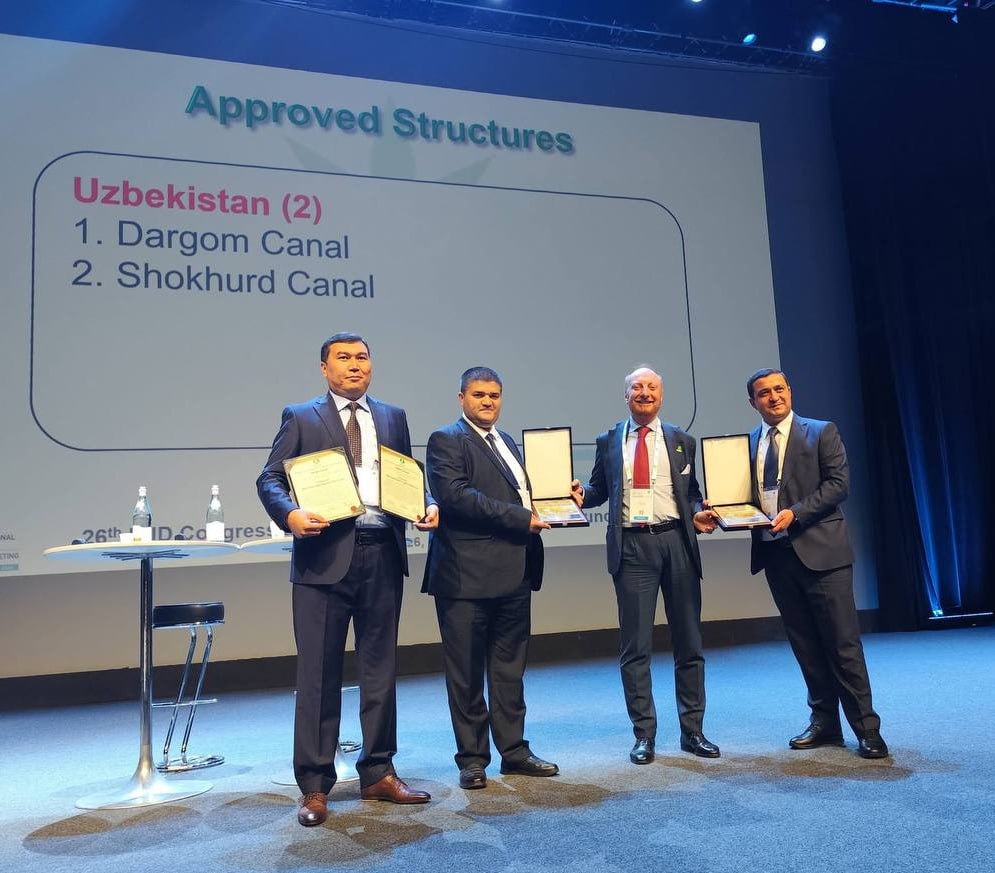
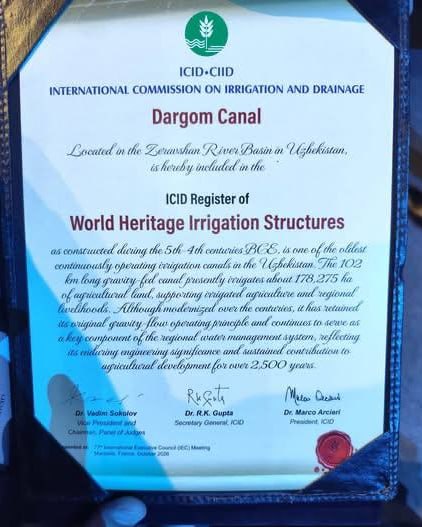
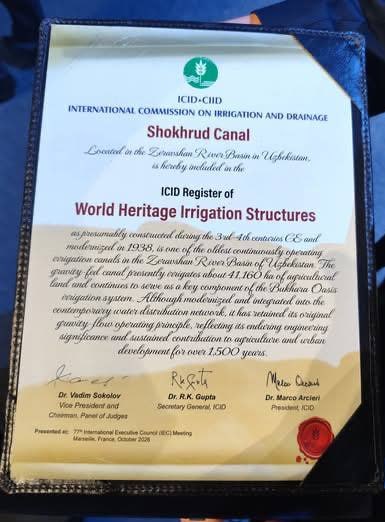
This status is awarded to historical irrigation and drainage structures of special engineering, economic, and cultural significance. Notably, both canals continue to operate within the water management system today.
The 26th International Congress of ICID and the 77th International Executive Council Meeting are being held in Marseille, France, on October 12–17 this year. Representatives of water authorities and national irrigation committees from nearly 50 countries, along with international organizations, scientists, engineers, and industry experts, are participating in the event.
The discussions focus on water resources management under climate change conditions, ensuring agricultural sustainability, and implementing modern irrigation technologies.
On October 14, ICID President Marco Arcieri and Secretary-General Rakesh Gupta presented certificates and commemorative plaques for the canals to Erkin Fayzullaev, Head of the Amudarya-Bukhara Basin Irrigation System Administration, and Farhod Rajabov, Head of the Zarafshan Basin Irrigation System Administration.
Dargom — a canal with more than two thousand years of history
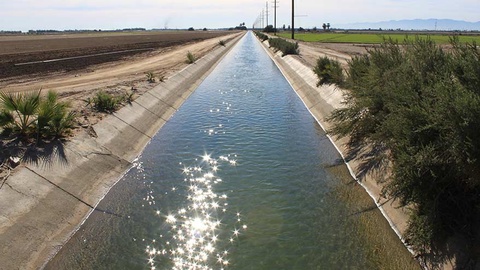
Dargom is considered one of the oldest operational irrigation systems in Central Asia. Its construction is recorded as dating back to the 5th–4th centuries BC.
The canal has been supplying water to the Samarkand oasis for over two thousand years. It spans approximately 102 kilometers in length and serves around 178,000 hectares of land across the Samarkand and Kashkadarya regions.
The system includes 146 hydraulic structures and 12 hydroposts. Dargom has preserved its historical route and gravity-flow water delivery mechanism.
Shohrud — played a crucial role in the development of Bukhara
The Shohrud canal is believed to have been excavated around the 3rd–4th centuries AD. It played a vital role in the development of the Bukhara oasis and the city itself.
For centuries, the canal delivered water to farmlands, orchards, vineyards, artisan quarters, residential neighborhoods, and the city's historic ponds (hauz).
The history of the canal is closely linked to the Historic Centre of Bukhara, which is inscribed on the UNESCO World Heritage List.
It is worth noting that in 2025, Uzbekistan's "Dustlik" and "Eski Tuyatortar" canals were also recognized as World Heritage Irrigation Structures.
Thus, Uzbekistan's ancient irrigation systems continue to demonstrate that they are not only valuable historical and cultural heritage, but also critical infrastructure for modern water management.