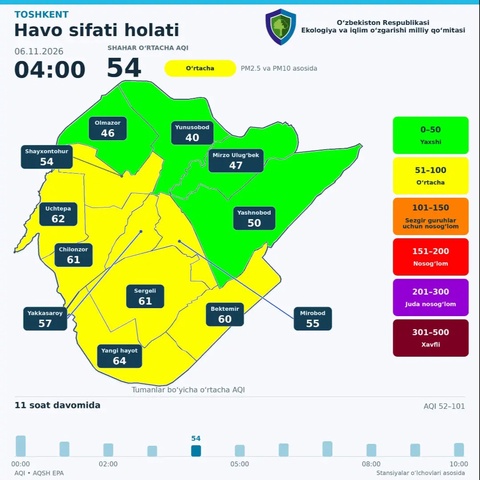

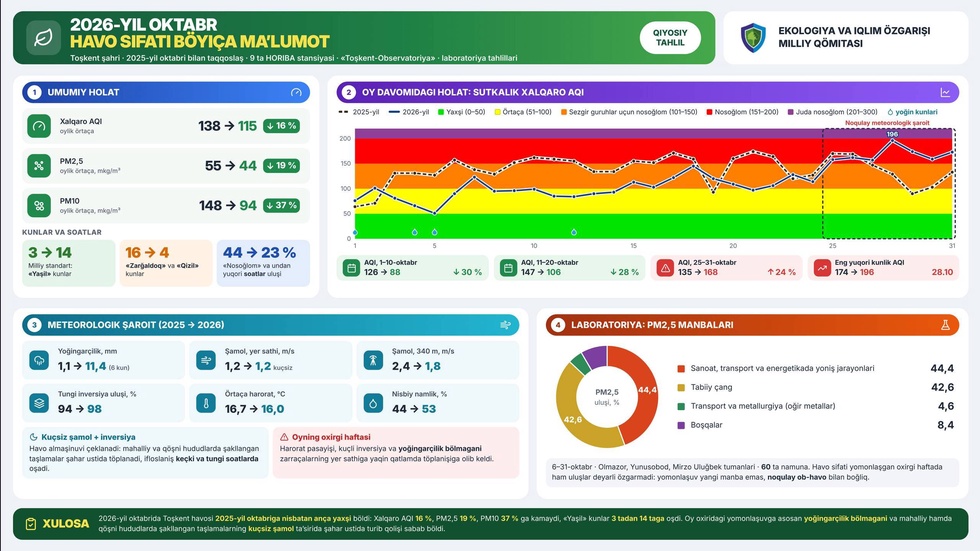
According to the National Committee on Ecology and Climate Change, the monthly average for the international air quality Index (AQI) decreased from 138 to 115. The concentration of PM2.5 decreased by 19%, and PM10 - by 37%. At the same time, the number of days with a "green" air quality level according to national standards increased from 3 to 14, and the number of days with "orange" and "red" levels decreased from 16 to 4.
However, the air quality remained unstable during the month. If in the first twenty days of October the indicators were significantly better than in the same period last year, then in the period from October 25 to October 31, there was a deterioration in air quality. This was facilitated by a decrease in temperature, low winds, frequent temperature inversions and insufficient precipitation, which limited the dispersion of pollutants in the atmosphere.
Weak winds and temperature inversions contributed to the accumulation of emissions from both the city itself and the surrounding areas in the air basin of Tashkent and its surroundings. As a result, the scattering of PM particles slowed down, and they remained in the surface layer of the atmosphere for a long time.
According to the results of laboratory analysis of 60 samples taken in October to determine the composition of PM2.5, an average of 44.4% were components related to industry, transport and fuel combustion in the energy sector, and 42.6% were dust of natural origin. Even on days of deteriorating air quality at the end of the month, there were no drastic changes in the ratio of these components.
Thus, in October 2026, Tashkent recorded a 16% improvement in atmospheric air quality according to the international Air Quality Index (AQI) compared to the same period last year.
The short-term deterioration in air quality at the end of the month was mainly due to the accumulation of emissions from the city itself and neighboring territories over the capital due to weak winds and unfavorable meteorological conditions.