
This is the conclusion reached by an international group of astronomers who modeled the movement of icy celestial bodies beyond the orbit of Neptune. new-science.ru.
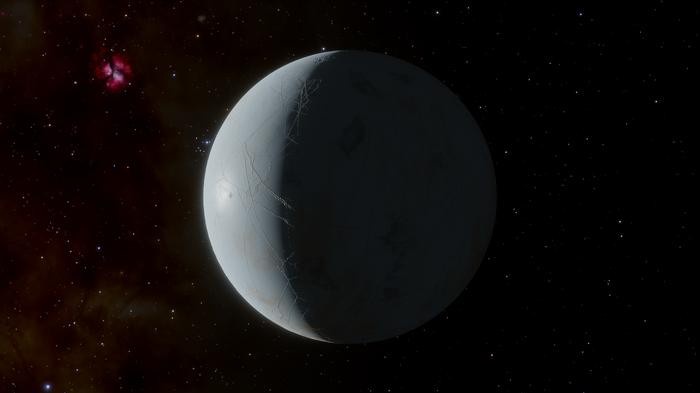
The proposed object was named Planet X2 (PX2). Its gravitational influence can explain the unusual orbits of a number of trans-Neptunian objects, which are difficult to reproduce in models with eight known planets.
The study was conducted by experts from Kindai University in Japan, the University of Southern Queensland in Australia and the University of Washington in the United States, led by Patrick Lykavka. Scientists have created computer models of the evolution of the Solar system, spanning 4.5 billion years, and traced how the gravity of giant planets influenced the movement of small icy bodies. The researchers focused on objects located beyond the orbit of Neptune. Most of the known Kuiper belt bodies orbit the Sun at distances of approximately 38-50 astronomical units. However, some objects move in much more elongated and inclined orbits. Sedna stands out among them, which is moving away from the Sun by hundreds of astronomical units. Modeling has shown that an additional earth-mass planet can significantly change the distribution of such objects. Its gravity is capable of removing small bodies from the area of strong influence of Neptune, increasing the inclination of their orbits and forming distant groups of objects whose characteristics resemble those observed. The most suitable models assume the existence of a planet with a mass of about two earths, moving in an elongated orbit with a semi-major axis from 350 to 500 astronomical units. Even at the point closest to the Sun, it would be about 200 astronomical units away from the star — almost seven times farther than Neptune. The researchers also tested an alternative scenario in which additional planetary bodies ranging in mass from Mars to Earth existed in the early Solar System. Calculations have shown that such objects were usually ejected from the planetary system over several million or tens of millions of years and did not create the distribution of distant icy bodies observed today. The proposed Planet X2 differs from the well-known hypothesis of the Ninth Planet, suggesting the existence of a much more massive object. The new model explains the distribution features of both strongly inclined orbits and distant bodies that practically do not experience the direct gravitational influence of Neptune. However, it has not yet been possible to obtain a complete match with astronomical observations. In particular, the size distribution of the orbits of some trans-Neptunian objects in the calculations differs from the results of real observations. The existence of Planet X2 also remains unconfirmed: no telescope has yet discovered the alleged planet.
New observations from the Vera Rubin Observatory in Chile will help test the hypothesis. Her survey of the sky will make it possible to discover many previously unknown trans-Neptunian objects, refine their orbits and compare the data obtained with the predictions of computer models. Direct detection of a distant planet is also possible, if it really exists. The study is published in the journal Monthly Notices of the Royal Astronomical Society.